Student engagement with feedback is about landing feedback so students can make sense of it – which does require an understanding of the metacognitive / cognitive / afffective dimensions. The latter is often underrepresented.
Feedback and engagement relates to baselines of quality and ensuring consistency in that quality for all students.

Effective feedback needs the learner to actively engage with the process, and not be a passive recipient. This requires active work on the part of the recipient of the feedback, and also effort on the part of the provider to ensure that the recipient is primed to use the feedback effectively. This process requires the student to reflect on their feedback (Winstone & Winstone, 2021)..
However, reflection on feedback is of limited value without the student then developing an action plan of where to take that guidance, and how to change their behaviours/actions for next time.
Sadler (2010, 2017) has bemoaned the amount of time spent contemplating feedback when efforts should be placed on supporting students to immerse themselves in situations where they are able to calibrate quality for themselves through carefully guided exercises such as marking and moderation of work.
The EAT Framework, in agreement with Sadler (2010) highlights the importance of broader interpretations of feedback to include students’ self-feedback and feedback seeking and using skills. She argues that given the vast number of variables impacting student receipt and use of feedback, assuming feedback is ‘good’ in the first place, efforts should be placed on designing integrated learning experiences which give students progressive opportunities to experience what quality looks like and how to achieve it.

This video focuses on the factors that will affect the impact of feedback that is provided.
Find out more about the factors affecting feedback impact
As a result of these variations, some form of scaffolding is required from the educator to help students filter important information from feedback, and build a development plan for their future endeavours.
New students need to be guided in how to extract useful guidance from feedback, and there needs to be signposts to what is more important advice, and what is of lesser impact.
Dealing with negative feedback
Several factors in the video relate to the students’ emotive response to feedback and their experiences of it. Impacts of feedback are negative where feedback is taken personally rather than at the task level (DeNisi & Kluger, 2000).
It is widely recognised that we often train our students to avoid feedback by making their earlier experiences of feedback negative ones (Winstone et al., 2016). Brief, terse, assertive or robust comments from educators can be misinterpreted as angry or aggressive by students.
DeNisi and Kluger (2000) highlighted the negative impact of feedback when it did not have the potential to impact on future outcomes (i.e. looking back rather than supporting moving forward).
In many cases feedback from educators can appear rude or overly personal. The immediate emotional impact of feedback can prevent a student from engaging with the rest of it (Jones et al, 2012).
click image to enlarge
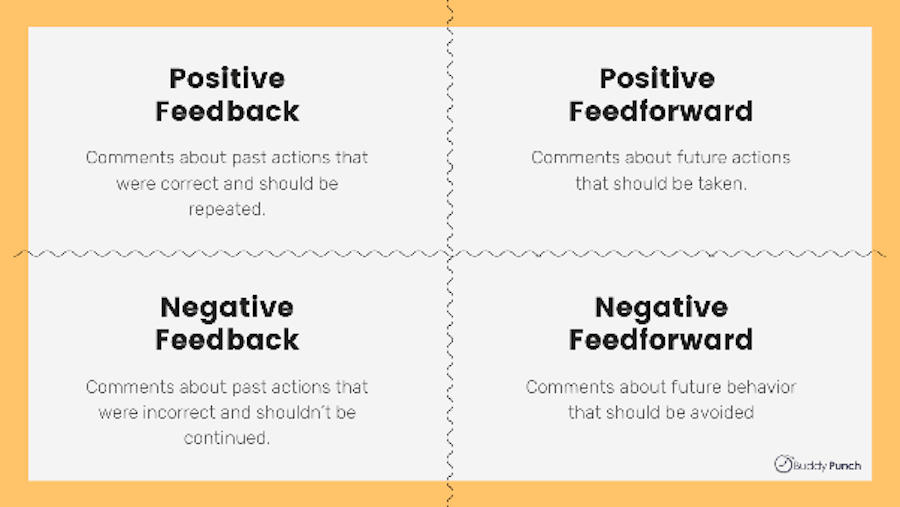
Students then expect to receive this type of negativity in future feedback, and will often choose actively not to engage with the feedback at all.
Key things to remember when delivering negative feedback:
* This work might be the best that the student has produced, so always treat it as such.
* Use of ‘softened negatives’, such as “It would be better if you did this…..” is preferable to pointing out something was wrong and offering a fix.
* Focusing on the work rather than the person takes the negative impact away from the student “This report….” Or “This way of phrasing….” are better than “You……”
* If using hand-written comments as feedback, avoid the use of red ink, as this is commonly perceived as negative and confrontational.
* If using written feedback, avoid the use of all capital letters, and numerous exclamation marks or question marks.
Supporting students to be resilient when engaging with their feedback is something we need to build as a life skill from an early point. But breaking them into this gently is more effective than a ‘sink or swim’ approach.