Feedback is typically seen by students as being very limited in scope of activities and approaches.

When quizzed about the nature of feedback, students typically perceive it as educator-written comments on a script. Usually this is expected at the end of a course/module, and when the grades/marks for an assignment are returned.
How can we go about changing this limited perception?
Fundamental to this change of perception is integrating feedback at repeated points within a course, and ensuring that feedback is considered proactively as part of assessment design process.
Aligning feedback to developing knowledge and skills places feedback as a central part of learning, not a detached additional activity after the learning is finished.
REFLECTION
To what extent do staff and students have a shared understanding of quality and efficiency of feedback?
Activity: Download the document with a table containing some suggested approaches to help embed effective feedback practices.
These provide suggested approaches to help embed effective feedback practices and are based on EAT decision-making cards. They focus on potential activities you could adopt – either yourself, or with colleagues, or with students.
Activity: For each of these approaches, based on the material in this module, consider what the rationale for this activity is, and then note down ideas of how you could embed this in your own practice.
The level of feedback typically seen by students has a very limited scope of activities and approaches.
How do we change this?
Fundamental is in assessment design and the planning of feedback as part of assessment design process. Thus aligning feedback to developing knowledge and skills.

PRACTICE / IMPACT
Conduct a review of the feedback students received on a specific assessment/module/programme and consider these questions:.
Are the messages consistent?
Do students get formative feedback to feed-forward usefully into summative tasks?
Are there opportunities for dialogue between the feedback giver and receiver, and are their goals aligned?
Is feedback a supported sequential process?
Do staff look at subsequent work of a student to see (and comment on) how they have acted on feedback?

IMPACT/SELF-EVALUATION
What could do you in your own practice/role to make feedback more accessible?
Consider the following:
1. Do you have agreed principles of effective feedback underpinning all programmes?
2. How are you ensuring consistency in the quality of feedback?
3. Is your strategy for implementing University strategy at the Faculty level clear to all?
4. How are you evaluating the effectiveness and efficiency of feedback mechanisms?
5. Is time built into workload models for training to ensure shared understandings of what the base line of quality is for giving feedback and for agreeing what constitutes good?
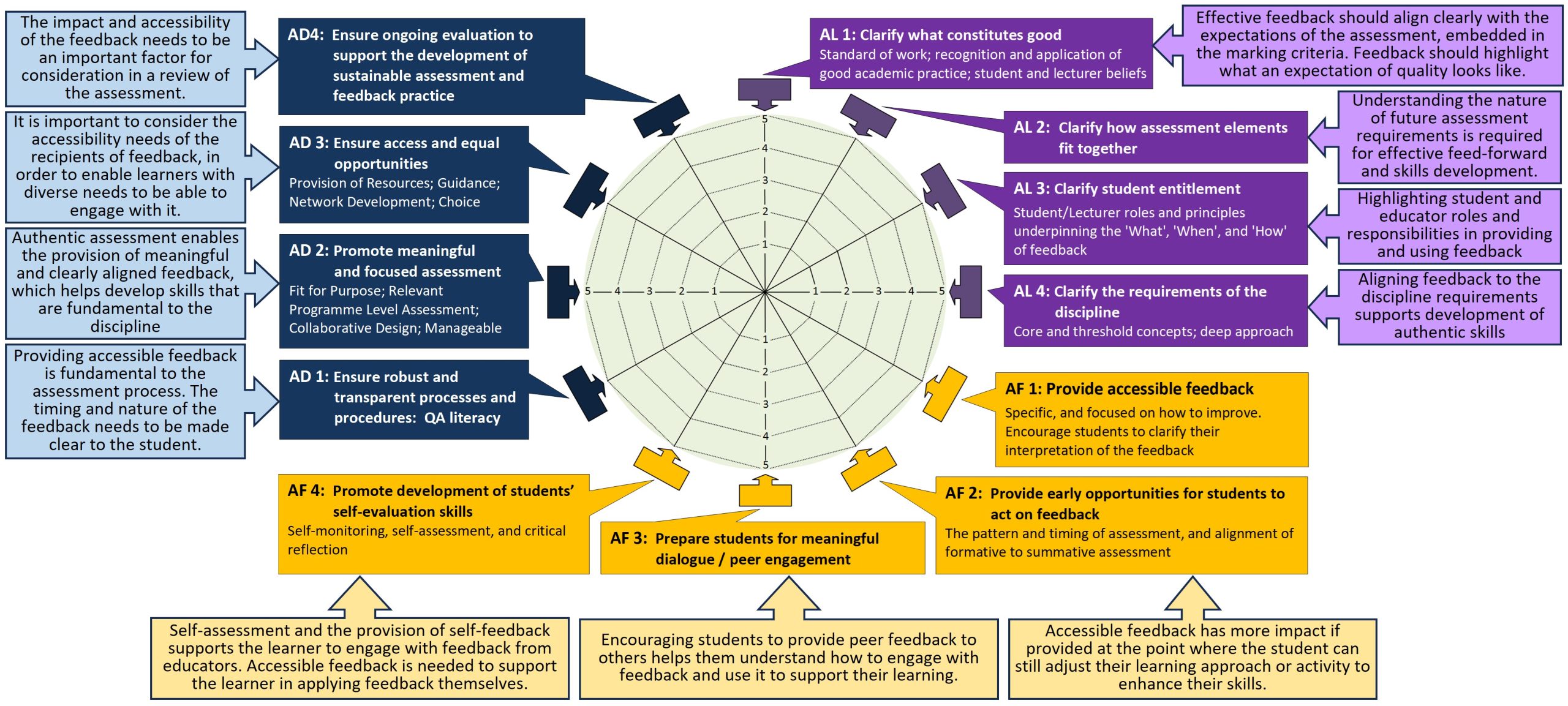
As with all sub-dimensions of the EAT Framework, AF1 impacts on all of the remaining 11 sub-dimensions. This figure summarises some of these potential impacts.
Are there any other effects that you can think of, that enhancing AF1 would have on the other sub-dimensions?
Click image to enlarge
Further reading download and access the reference list