One of the fundamental ideas of inclusive assessment is that inclusive design means that who requires additional accommodations to support disability and other needs, should already have been resolved within the design of the assessment. For example, providing the tools for a student to meet the requirements of assessment (e.g. ensuring assistive technologies to support dyslexic students with writing) and/or providing a different format (visual submission) if this does not compromise the requirements of the task.
There are additional support needs that learners may have, represented by the ‘pyramid of support’, shown in this figure, and the following video.
click image to enlarge
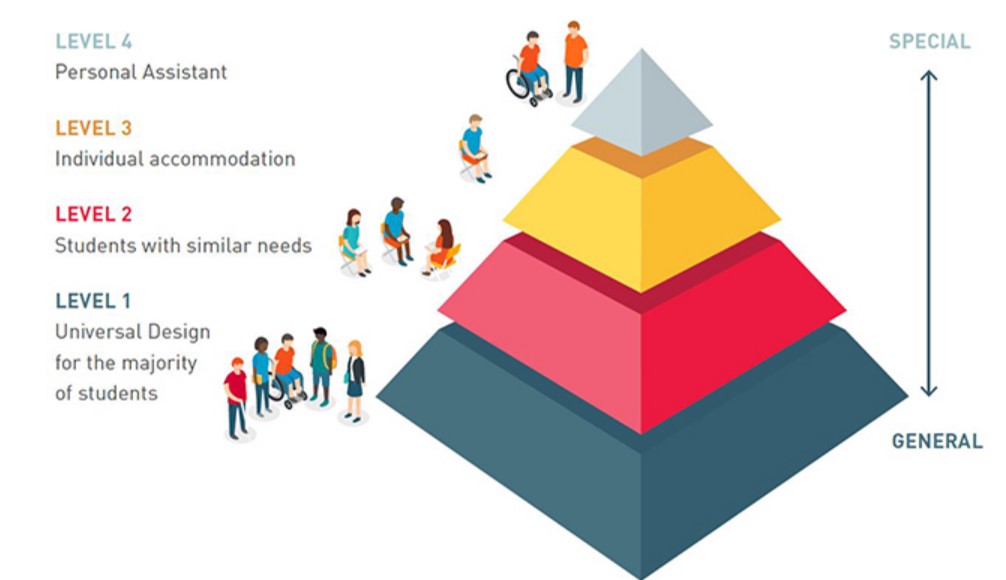
Ensuring early and full provision of resources is one way to promote access to learning so students can manage their workload to suit their lifestyles is key. Supporting students to develop strong resource networks (e.g. appropriate sources of information; relevant research/discipline groups; peer groups, academic and professional mentoring etc.) are additional ways to address the limited academic and social networks that some students have.
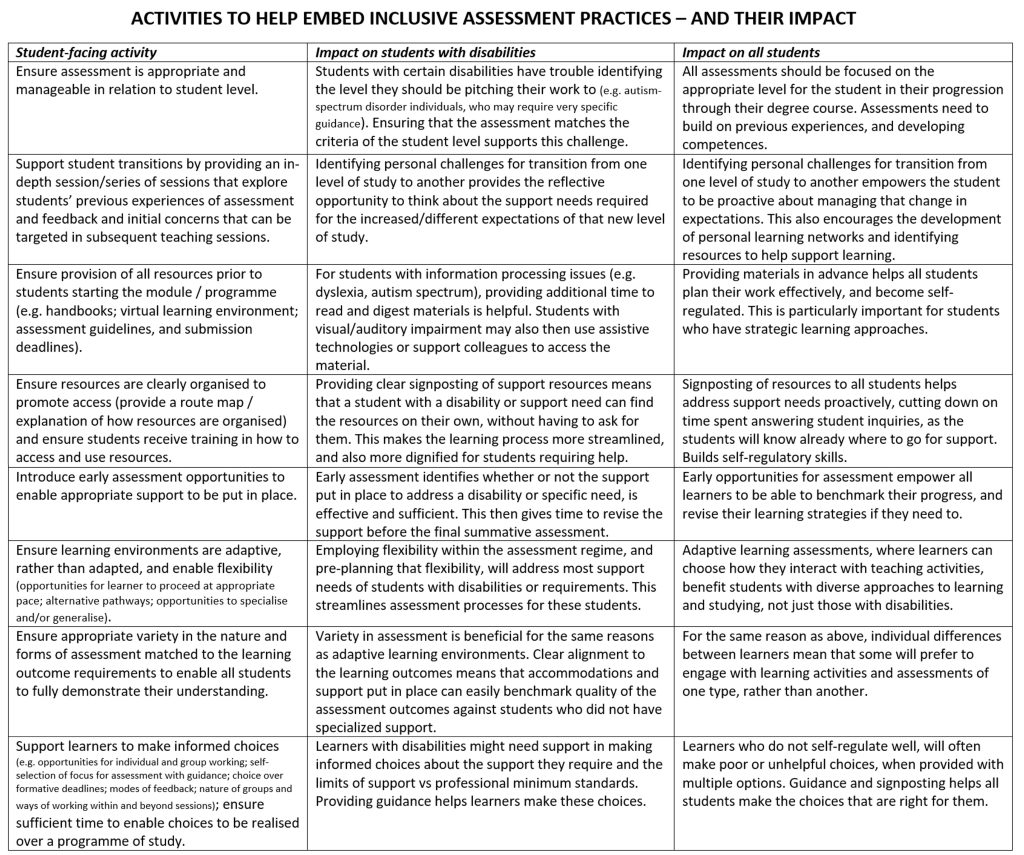
This table, taken from the EAT Decision-Making Cards, suggests some support resources and approaches that you, as an educator, could put in place for your students. The table suggests ways in which these accommodations could support both students with disabilities and all students in general. One of the main tenets of inclusive education is that accommodations made to enhance and level the experience of students with disabilities or specific needs, actually benefit all students.
The key emphasis of EAT is that inclusion should be embedded in design which should mean additional accommodations should be minimal. In developing inclusive contexts integrated approaches to inclusion are needed across institutions to ensure the basics of access are addressed e.g., assistive technologies for all.
Students also need signposting to what supports are available to them. For more information on this see the Institutional Inclusion Framework
The need for alternative assessments should be minimal as these should be embedded in assessment design and students at point of entry to a course should be aware of the range of adjustments available within a programme and also where this is not possible without compromising standards so they can make an informed decision.
This Table suggests activities to help embed inclusive asswesssment.
click image to enlarge
REFLECTION ACTIVITY
Evaluate your own assessment practices, regarding the extent to which alternative assessments are provided for students with disabilities, if they are provided, are they done on a bespoke basis case-by-case, or built in to the design of the assessment?
Would it be possible to build in alternate modes of assessment to address the more common alternative assessment requirements?
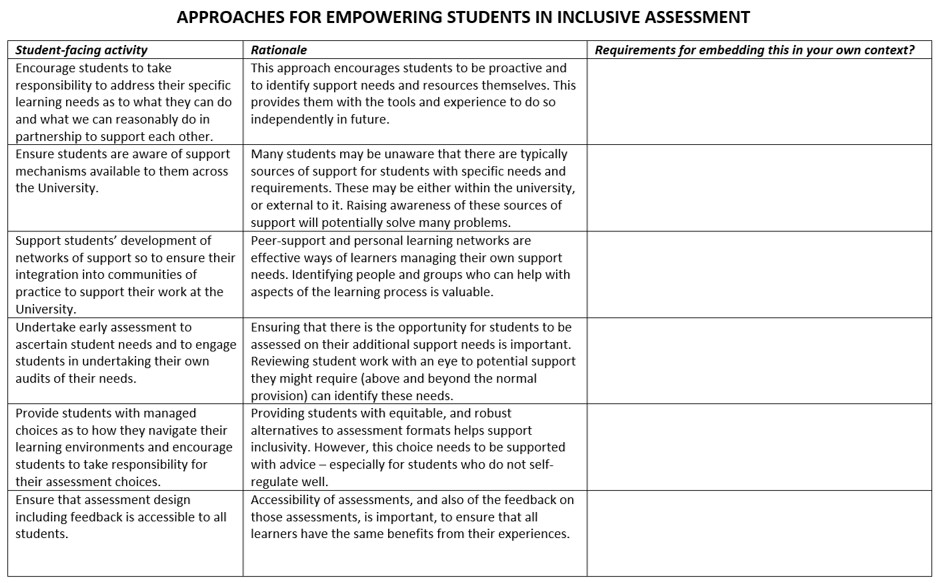
An important approach to take with students is to encourage them to build strategies that support their particular needs and requirements, as support for these will likely not be offered in post-university environments. One of the important elements of this is supporting learners to identify sources of support (both people, groups and resources), and embed them into their learning approaches.
click image to enlarge
PRODUCTION ACTIVITY
Download this document. The table provides questions for curriculum designers. Answer these questions within it, relative to your own context and level of agency (the extent to which you can control what is delivered).
This can be at the level of an individual assessment or a course, or might be a strategic impact at the School/Department/Faculty level, or institutionally.
Now that you have filled in that appropriate column, then complete the other columns, but with the perspective of “What is the current state of this?” at the different levels specified. You may not have any control over these other levels, but they will influence the aspect that you do have control over.
What could you do to make or encourage these changes?