Module and programme leaders need to agree and clarify with students from the outset what meaningful student engagement in assessment involves and what the protocols are.

A fundamental principle is: Academics should design assessment environments that enable students to step up.
Many students will need help in making the leap from receiver of knowledge to generator of knowledge. 
It is up to the educator to provide any scaffolding needed for this shift to take place.
This process involves the educator giving up some of the power and control traditionally ascribed to them in their role. This can be unsettling for both the educator and the student!
Students also need to be supported in making the transition from teacher-focused assessment (i.e. Designed and led by the educator) to student-led assessment (i.e. the student has a strong voice in deciding the focus/parameters of the assessment, and how they demonstrate achievement of the Learning Objectives) (Samuelowitz and Bain, 2002).
INVESTIGATION ACTIVITY
· Download this document (it is ‘Appendix F’ of the EAT-Erasmus Self-Regulation Report). This is a list of different activities undertaken with assessment, that can be either educator or learner focused in how they are carried out.
· Pick an assessment that you either deliver, help deliver or support, or have experienced as a student yourself.
· For each of the activities, rate it on a scale of 1-5, according to how close to either side of the spectrum it is.
· What do you think about the outcome? What elements might you wish to change in the future?
A key thing to question is how clear and effective is the guidance that you are providing?
To what extent does the guidance empower the students to be involved and proactive in the assessment activity.
To what extent does it position them as dependent on you for support and help?
REFLECTION ACTIVITY: Boundaries of engagement
For an assessment with which you are involved (either running it, supporting it or taking it!), consider the following questions:
· Are the expectations clear?
– Are they agreed at the beginning of a course?
· Do your students have allocated space and time to organise their work?
· Are you designing assessment environments that support students to ‘step up’ as active agents in their own learning and demonstration of their competence?
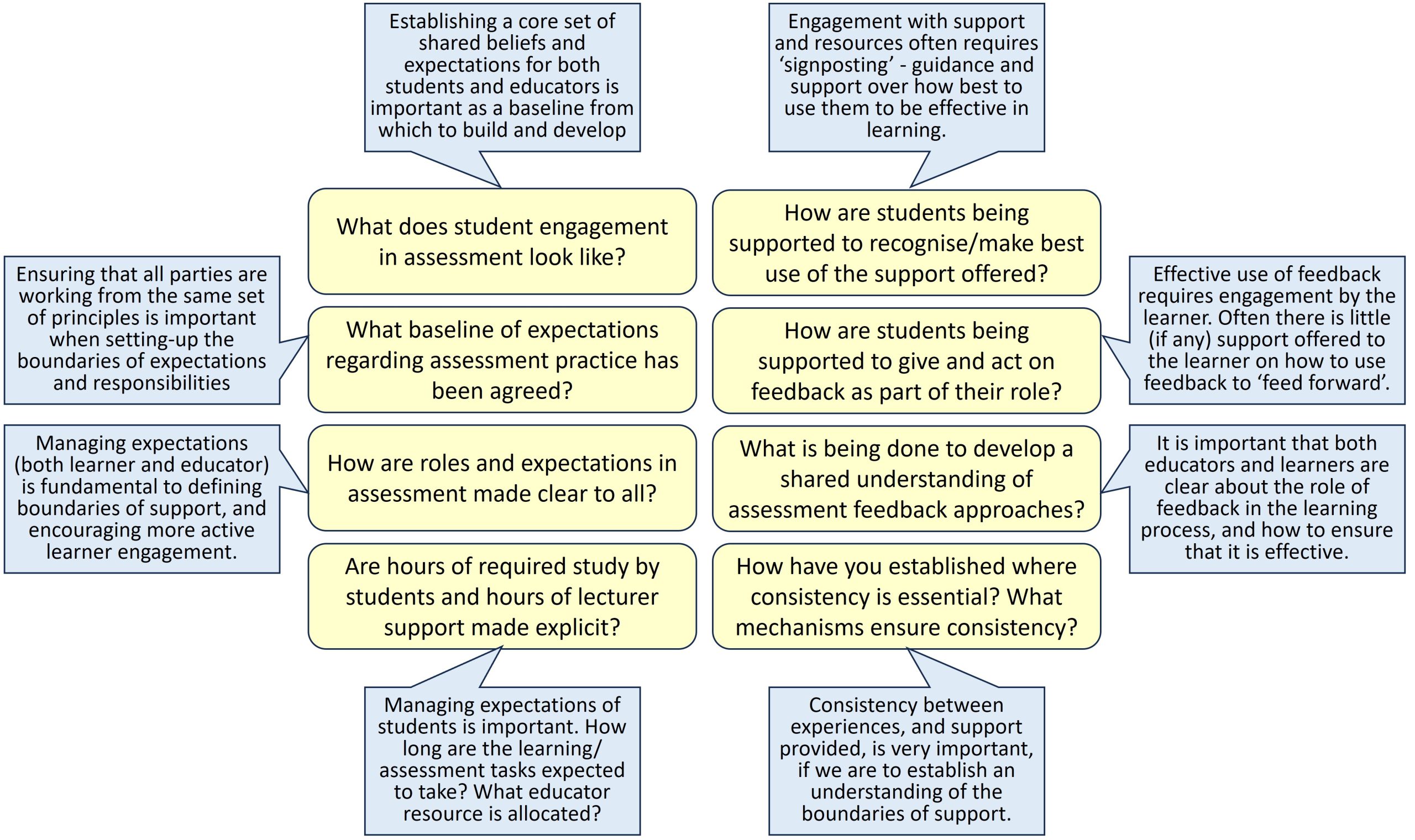
The next diagram shows some key questions to ask, from an educator perspective.
click image to enlarge