One of the most common concerns for academic staff relating to assessment is the time commitment it requires – either in setting, supporting, providing formative feedback, and/or marking/grading and providing summative feedback. This dimension of clarifying student entitlement is key to addressing this challenge.

A key factor to impress upon students in a class is that the educator is not an infinite resource! Staff have many duties they undertake, and teaching a particular class of students is typically only one of these.
The time allocated to supporting students has to be rationalised.
· Too much support inhibits the development of independence and self-regulation skills
· Positioning and timing of support needs to be optimal to empower the student to take ownership of their learning and development for the assessment.
· Sufficient time needs to be allocated for the educator to provide formative support, and for the student to then put it into action.
The consideration of timing in assessment activities – especially relating to feedback – is addressed more in Module AF2 (Timing of feedback). However, an element to consider here is how you define the limits of staff support for students in an assessment.
PRACTICE ACTIVITY
Produce a plan to optimise the IMPACT of staff interventions on the student experience by CO-NEGOTIATION WITH STUDENTS.
Activity: Consider the following issues
How could you go about gaining a collective decision from the student group about:
· The best time-point to receive support –
· When is the most impactful moment for providing feedback/guidance (front-loaded? Formative feedback mid-way through? Summative feedback at the end?)
· How can students fill in any gaps in support by supporting each other and developing an engaged and agentic approach to the assessment?
– Within the parameters that your own time is limited, and you can provide detailed support at one, maybe two, points, but not continuously. So what do they think would be the most useful?
SUMMARY
Encouraging student agency in the assessment process is a powerful way to support learners to feel included and active agents in their own learning.
How do we move students from being passive recipients of knowledge to active partners in the learning process?
Identifying where educator support stops and what the learner needs to do in order to meet the necessary expectations and standards is important. Emphasising that the learner has an important and active role to play helps provide the necessary scaffolding to help the learner build and effective learning environment for themselves.
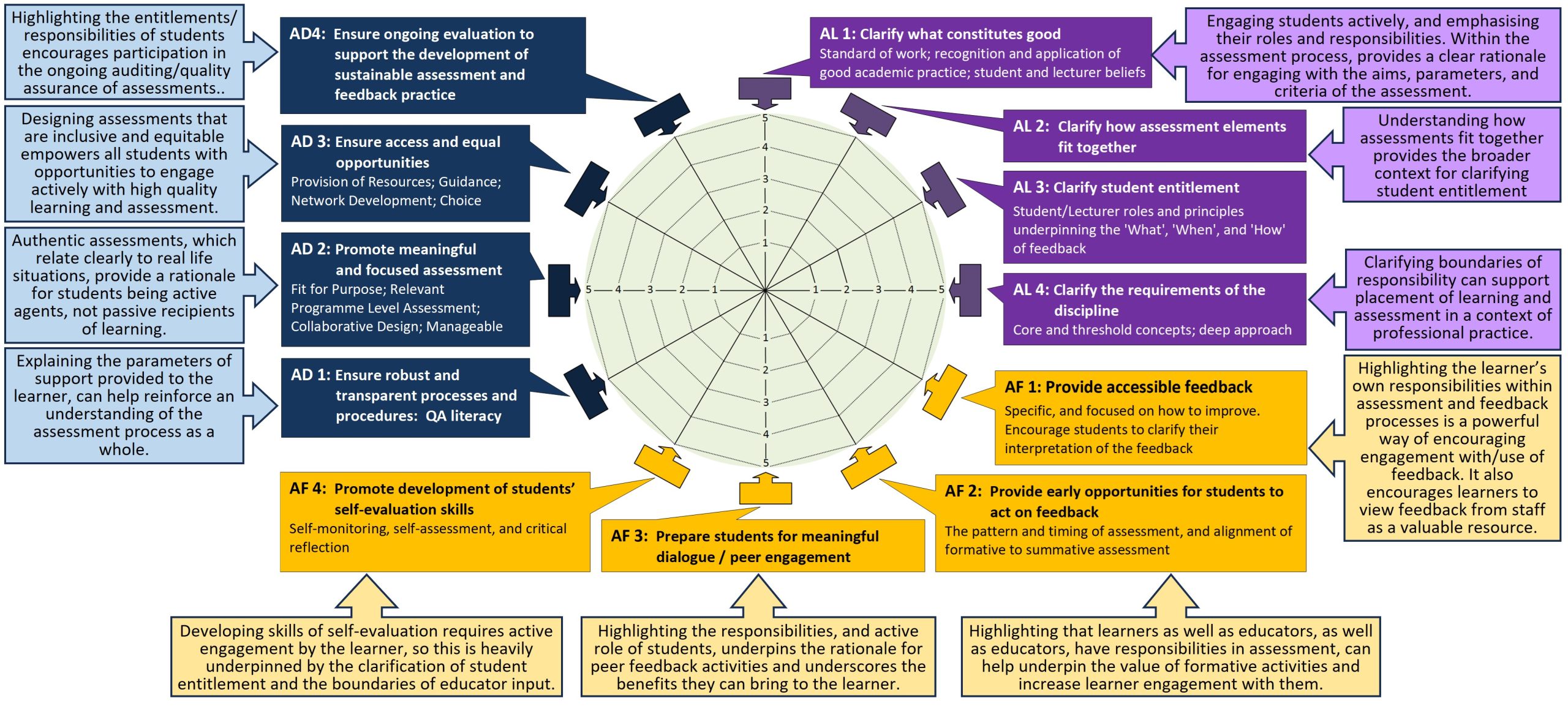
This dimension of the EAT framework is fundamentally linked to all of the other 11 dimensions, and associates very strongly, or is underpinned, by many of them. This diagram summarises some of the ways in which other dimensions of the EAT Framework interact or intersect with ‘Clarifying
click image to enlarge
Activity: Download and review the reference list for this module