Tai et al. (2022) discuss a series of assumptions about assessment which underpin much of current educational practice in HE. The authors question these assumptions from an inclusion perspective and from a basic assessment design perspective.
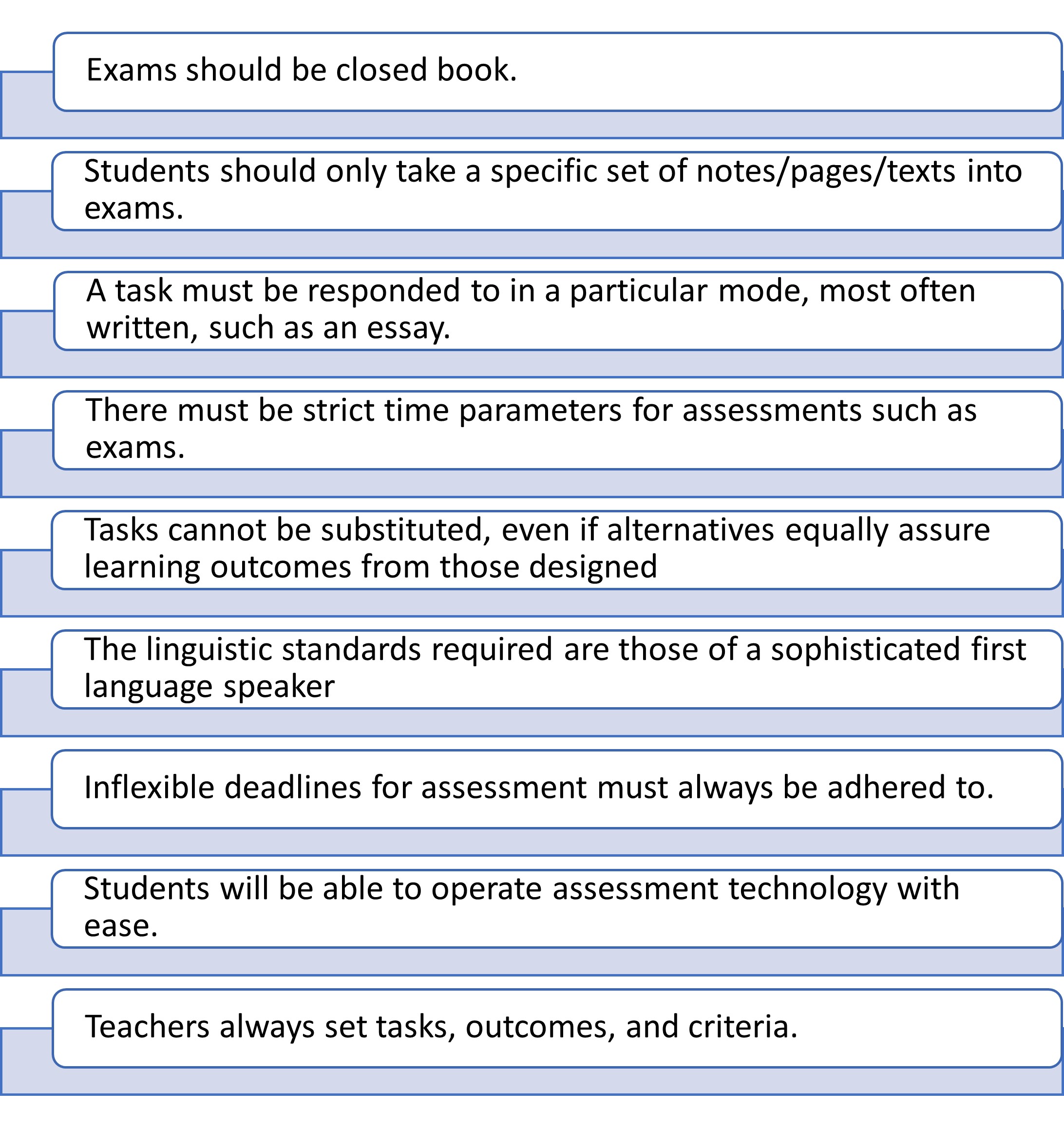
Activity: The nest diagram shows some of the many approaches that would benefit from being rethought in mainstream assessment. They also may have impacts on inclusion.
click image to enlarge
INVESTIGATION ACTIVITY
Activity: Considering these 9 assumptions in the list shown, what would you see as the problems with them when viewing them from:
a) The perspective of assessment design
b) The perspective of inclusion for all diverse learners.
What are the problems or barriers that such assumptions might present to fair and effective assessments
Consider what would be relevant to your own context and your discipline.
To what extent do you agree or disagree with these assumptions, and do you feel the assumptions are representative of your own experience as an educator of the environment in which you are embedded?
Activity: Read the paper by Tai et al. (2022) and in particular note the 9 assumptions that they refer to (pp. 487-488).
Do your perspectives align with those of the authors?
In what ways are they different – especially from the perspective of your discipline?
Revising marking criteria
In order for adaptive and inclusive assessments to be fair and accessible to a variety of learners, they also need to be robust and test the same learning outcomes to the same rigour. The assessments therefore need to have clear marking criteria that are common between assessment types, but specific enough to align with the varied activity.

This is where considering programme-level outcomes is useful. They will focus more on broader skills, than specific pieces of knowledge. It is possible to devise criteria that test critical analysis, or presentation skills, accuracy of knowledge, depth of knowledge and understanding, innovation and creativity, in generic criteria that can then be applied to any mode of assessment.
You could, for example, have 80% of the criteria based on very generic criteria, and 20% on skills that are specific to that mode (such as writing style for an essay, slide format and content for an oral presentation).
PRODUCTION ACTIVITY
For an assessment in which you are involved (either as a leader, co-marker, or as a learner), examine a context where you have given students a choice in assessment.
Compare the extent to which the different assessment choices you have identified enable students to meet the programme learning outcomes equally.
Was it easier to meet the assessment criteria and programme learning outcomes in assessment task compared to another or was it equal across both tasks.