Assessment needs to be inclusive for all learner types, so that you can be assured that the assessment is focusing on the learning of the content or skill, and is not being affected by any other factors.

Recognising individual differences between learners means that we should consider the assessment modes used as not all of them suit all students.
Some students will perform better at certain tasks than others (Mountford Zimdars et al., 2015), which bears no relation to their mastery of the subject matter or disciplinary skill, but rather to their aptitude to a particular method of activity.
You may therefore be restricting a learner’s ability to demonstrate mastery of the subject, but evaluating them through a method which may be sub-optimal for them.
According to Dyson et al. (2015) perceptions of equity and fairness permeate how students perceive assessment. It is therefore important that students feel that the assessments they undertake are fair and achievable, with no barriers to the learner performing to the best of their ability.
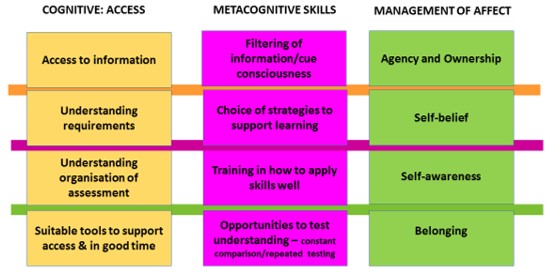
The next figure, taken from Evans’ work on inclusive assessment with the DPVC Network (Advance HE) (2022), summarises some key issues to consider when designing inclusive assessment from a self-regulation perspective, focusing on the cognitive, metacognitive and affective (motivational) domains of self-regulation.
click image to enlarge
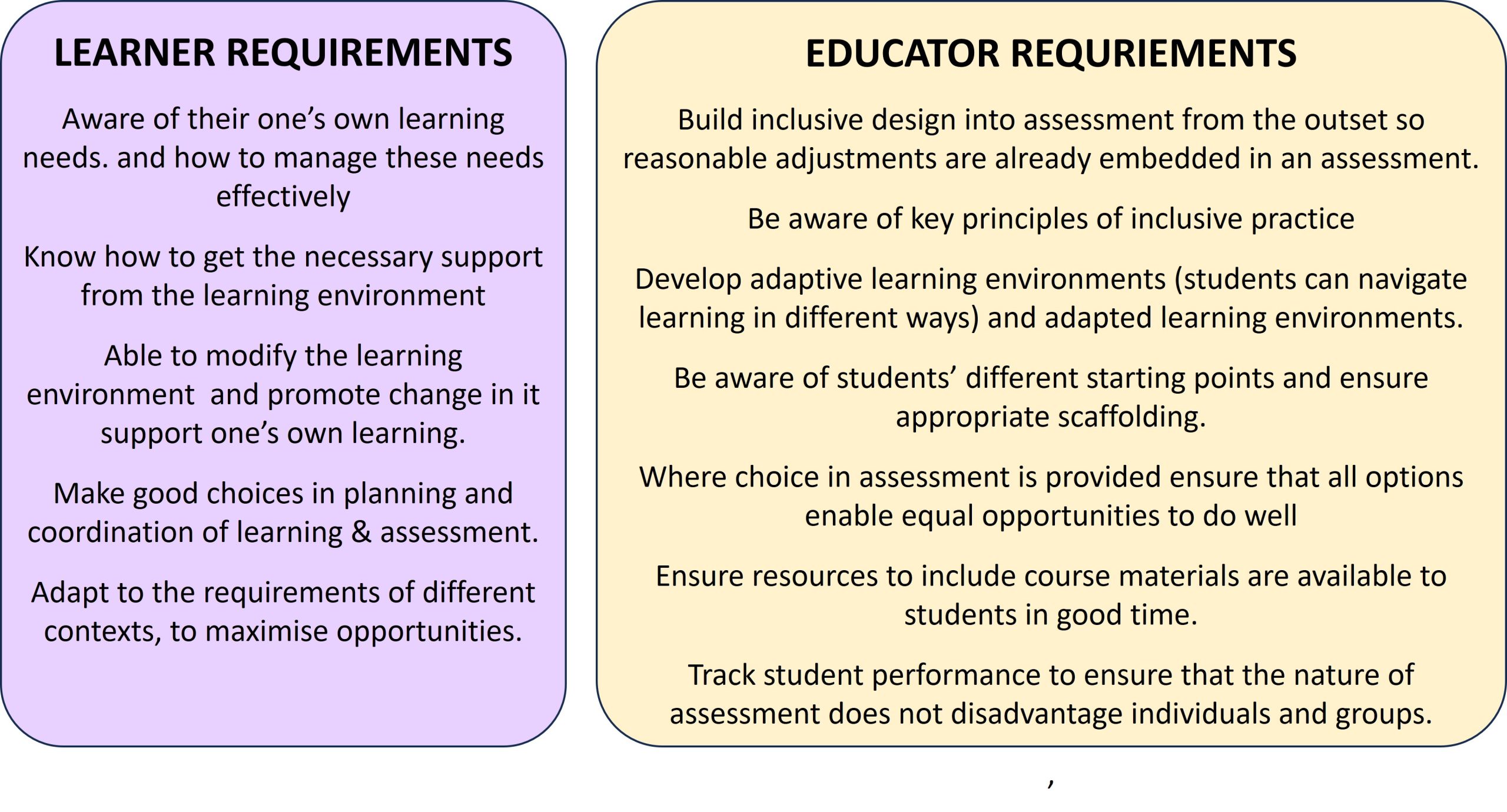
The metacognitive requirements on both the learner and the educator, are varied, but need to be considered in order for an assessment to be truly inclusive. Learner responsibilities concern monitoring and evaluating their own practice and attainment.
Educators need to focus more on wider logistical considerations, such as when, where and how the assessment will be undertaken. This figure lists some of these key considerations.
click image to enlarge
The importance of equity and equality within assessment, as well as teaching, and social interactions, is substantial But the concepts of equality and equity are subtly different. The next section will investigate these in more depth.

DEEP DIVE
Activity: Review the deep summary of key issues related to inclusivity in assessment. In particular it presents the ‘Disability Inclusion Institutional Framework’.
The website notes: “The Disability Inclusion Institutional Framework (UK) is the outcome of robust systematic review of approximately 500 articles from an initial data base of approximately, 11,000 peer reviewed academic papers on disability inclusion (DI) involving lead authors from 50 countries.”